BluntlyAI
Multi-LLM AI data analyst producing automated reports
#problem
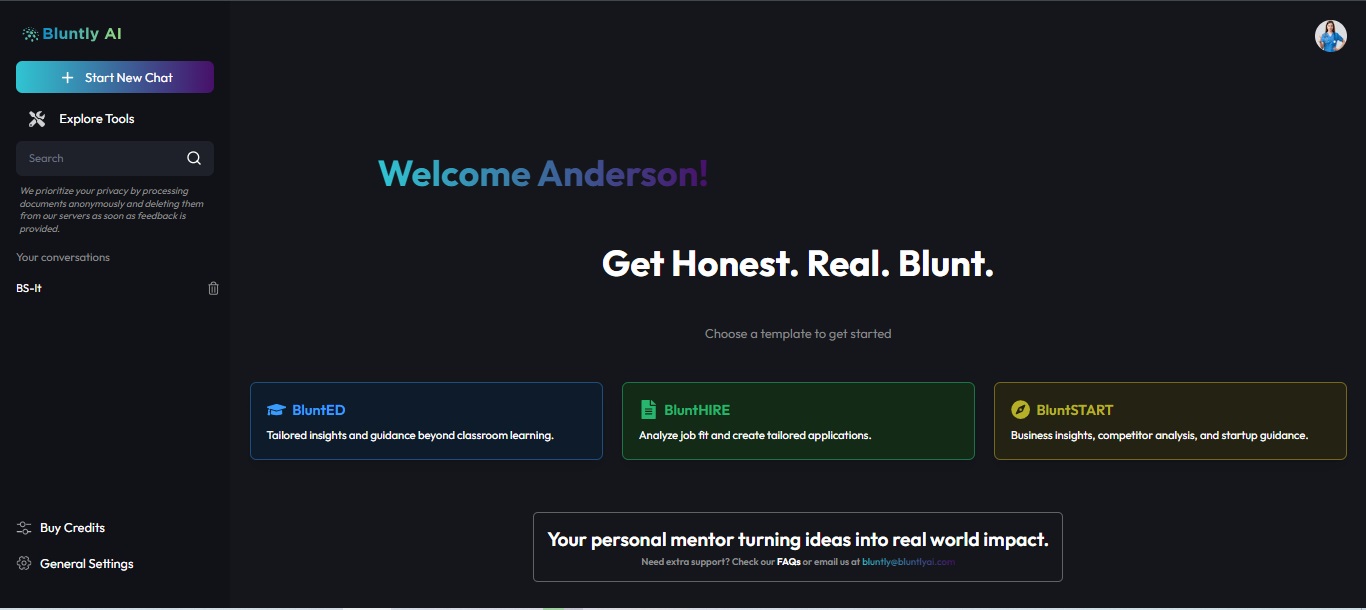
BluntlyAI is an AI data analyst product that ingests complex datasets and produces clear, actionable insights and automated reports. It addresses the gap between raw data and decision-ready analysis by coordinating multiple large language models through OpenAI to interpret data and generate written summaries. The system pairs a NestJS API layer with a Next.js front end and runs on AWS.
#what-i-built
I architected the BluntlyAI platform end to end, designing the NestJS backend, the Next.js front end, and the AWS deployment.
I built the NestJS services that orchestrate multiple LLMs via OpenAI to analyze datasets and generate automated reports.
I designed the data analysis pipeline that converts uploaded datasets into structured insights and written report output.
I developed the Next.js interface where users submit data, review generated insights, and access automated reports.
I deployed and operated the application on AWS, owning the cloud infrastructure and release process.
#stack
#outcome
Production multi-LLM AI data analyst platform live at bluntly-ai.com: full-stack ownership across the NestJS analysis backend, OpenAI multi-model orchestration layer, and AWS deployment.
#key-decisions
Orchestrated multiple LLMs through OpenAI rather than a single model, routing summarization and pattern-detection subtasks to the best-fit model for each.
Separated the analysis pipeline as a NestJS service layer from the API controllers: independently testable and swappable without touching request routing.
Built report generation as an async pipeline with per-step error boundaries so a failing analysis step degrades gracefully rather than returning a blank result.
Chose enforced TypeScript contracts between NestJS and Next.js to reduce runtime data shape errors at the API boundary.
Building something similar?
Let's talk about your project. No obligation.